
Now Reading: Every Scar’s a Cornerstone
-
01
Every Scar’s a Cornerstone


By Alina Halai for Young N’ Loud Magazine
Fourteen years is a long time to be away. But Grit Cathedral’s founder will tell you the break was the point.
When his previous band fell apart after a decade of gigging, he walked away from the scene. What looked like quitting was actually something else: he kept practicing, kept writing, spent years obsessing over film scores and composition, built a career running engineering at a tech company, and flew around the world watching the bands he loved. He came back when he was ready. With the financial backing to do it properly, the knowledge of how to build something that lasts, and one non-negotiable: no compromises on the music.
That’s the foundation of Grit Cathedral. Everything else followed from there.
Grit has an actual definition
The name came from him, like the songs, the lyrics, the identity, the strategy. It had to mean something personally.
Grit: the combination of passion and perseverance toward long-term goals. The ability to sustain effort over years, despite obstacles, failures and plateaus. One word that describes him entirely. The Cathedral is the community built around it. A gathering place for people wired the same way, people willing to push through for what they believe in, people who want to make the world a better place. Because turning things around, as he puts it, is going to take a lot of grit.
The runner-up was Superhero Society. His whole team was in favour. His wife convinced him otherwise. A good husband always listens to his wife, he says. Superhero Society became a song instead.
A Central European alliance
Grit Cathedral is not a local band in any traditional sense. The founder and drummer Jure are based in Slovenia. Bassist Luka is Croatian, living in Ljubljana. Singer Kati is from Austria. Borders, as they put it, do not define them.
The Slovenian scene is tight-knit and everybody knows everybody, but coming from a small country shapes your mindset more than your sound. Small starting fanbase, no major label interest, no financial safety net. What it taught him: set goals so big they feel unattainable. You’ll push harder for them and achieve more, even if you never quite get there. His benchmark is a sold-out Wembley Stadium. He laughs when he says it. He means it.
The sound came from MTV, not geography. Weekends at his grandmother’s place watching the Top 100 rock charts, live specials, Unplugged sessions. “November Rain.” Metallica’s “One.” Early Bon Jovi. Meat Loaf. That’s what got him into rock. What shapes Grit Cathedral now is heavier and more modern: Bring Me the Horizon, Five Finger Death Punch, Evanescence, Daughtry. You can hear it in everything they’re building.
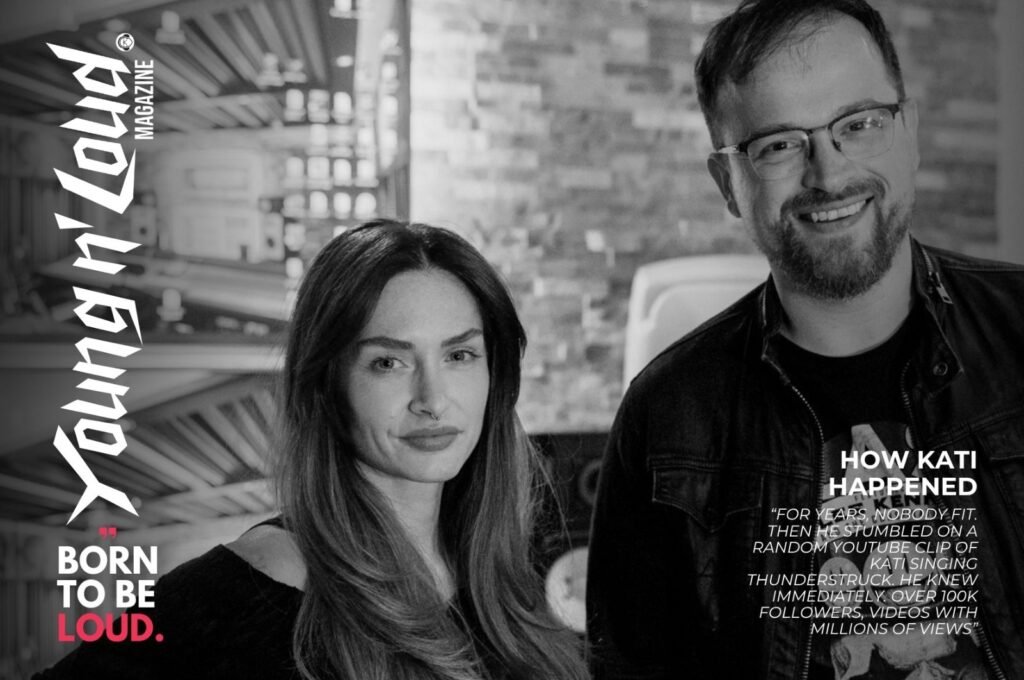
How Kati happened
He knew what this band needed at the front. For years, nobody fit.
Then he stumbled on a random YouTube clip of Kati singing Thunderstruck. He knew immediately. Over 100k followers, videos with millions of views, the kind of rock voice that hits 11 without effort and makes it look easy. She gets pitched constantly, so it took a few emails and conversations before she took him seriously. He was stubborn about it. When you hear the pre-chorus of I Pray for Peace, you understand why.
There was no first rehearsal. Jure and Luka, both touring and recording pros, came into the studio cold with demos. One morning for drums and bass, mostly first or second takes. Then Kati flew in off a Rock Meets Classic tour, recorded vocals and shot the video the very next day, and handled all of it like the pro she is.
The this is it moment came from Luka. He’d known Jure was world class for years and had been following Kati for two. But when Luka plugged in and started laying down his grooves, every face in the studio lit up. The last few percent he’d been hunting for. When producer Matej Pečaver sent over the first mix, it hit him straight in the face. They had something.
What the Hans Zimmer years built
He stopped looking at songs through a guitar player’s eyes a long time ago.
Five years completely obsessed with film scores. Studying composition, building scores with sample libraries, learning how a hundred instruments work together. It changed how he hears music. Every note matters now. The beat, how the bass grooves against it, which spaces the guitar actually needs to fill, the melody, the lyrics, the message — how the whole package works together. Arrangement became everything.
Night and day from where he started, when the philosophy was simply: more guitars, more solos.
His signature sound, he’ll tell you honestly, is still being earned. They’re one single in. What they do have from day one is a signature voice. Kati is recognisable within seconds. If anything is unmistakably Grit Cathedral right now, it’s her.
Fire
If the music had a color or a texture, he says it would be fire.
Not noise for noise’s sake. Every song written like it needs to reach the last row of an arena. Riffs that hit you in the chest, drums you feel in the floor, and on top of it all a voice that can carry the whole thing. A fist in the air and a lump in your throat at the same time.
I Pray for Peace was inspired by his wife, who believes every small act can change the world. The character in the song performs in small clubs, and if she inspires even one person a night, she considers the evening a success. That’s where the song comes from. The next single continues in the same direction, celebrating everyday people, quiet heroism, the kind of goodness that doesn’t make the news.
Darker material is coming too. Songs about personal struggle, what it actually feels like, and what it looks like to come out the other side stronger. That’s the other side of the name. The grit part.
What he wants people to walk away with: pay attention to the world around you. Celebrate the good in people. Love the people close to you. Stop giving power to the wrong ones. If someone leaves with even one of those four, the job is done.
What’s coming
A five-song EP. Studio in September or early October, release to follow. If you liked I Pray for Peace, he says, you’re going to like them a whole lot more after you hear it.
Dream collaborations: Eddie Van Halen, first and always. And still possible: Mark Tremonti on guitar, Chris Daughtry on vocals. He’s been to their shows, credits them as a big part of what pulled him back into the studio. Having them on a Grit Cathedral track would be a full-circle moment.
Success right now is the band generating enough to keep funding studio time so they can keep making music on their own terms, for years. That’s the practical definition. And then there’s Wembley. He laughs again.
Music, he says, is the closest thing to magic we’ve got. He means that too.
Grit Cathedral’s debut single I Pray for Peace is out now. Their EP drops later this year.