
Now Reading: Between Red Velvet Curtains and California Sunsets: The World According to Lily Kincade
-
01
Between Red Velvet Curtains and California Sunsets: The World According to Lily Kincade
Between Red Velvet Curtains and California Sunsets: The World According to Lily Kincade


Young N’ Loud Magazine
There are certain artists who write songs, and then there are artists who build places.
Spend enough time listening to Lily Kincade’s music and it becomes clear that she belongs firmly in the second category. Her songs do not simply tell stories. They create landscapes. They invite listeners into carefully crafted worlds filled with memory, longing, hope, heartbreak, and the quiet realization that growing up rarely happens in a straight line.
For Kincade, music has never existed separately from life. Every project, every lyric, and every melody feel connected to a specific chapter of her personal journey. The result is a catalog of work that feels remarkably intimate while still managing to speak to universal experiences.
Long before she was recording albums or performing headline shows in Los Angeles, she was simply a young girl writing songs because she could not imagine doing anything else.
The Girl Who Turned Memories Into Melodies
Most songwriters can remember the first song that made them believe they wanted to become artists. For Lily Kincade, songwriting arrived much earlier than that.
Her first composition was written while she was still in kindergarten. The subject was her childhood dog, Molly. While many children move from one interest to another, Kincade never left songwriting behind. The habit became a constant companion throughout her childhood and adolescence.
Every emotion, observation, and experience eventually found its way onto paper.
What makes this detail particularly important is that songwriting never appears to have been a career choice for Kincade. It was simply part of her identity from the beginning. The songs arrived naturally, and over time they became the primary lens through which she understood the world around her.
That connection only deepened as she grew older.
At fourteen years old, she left Kansas City and moved to Los Angeles, a decision that would ultimately shape both her future and her artistic voice.
Falling in Love with California
Many artists speak about cities as locations. Lily Kincade speaks about them as relationships.
When discussing Los Angeles, there is an unmistakable affection in the way she describes the city. It is not difficult to understand why. Los Angeles represents much more than geography in her story. It represents possibility.
The city became the backdrop for her creative development and continues to influence her songwriting today. Its contradictions are particularly fascinating to her.
Los Angeles can feel glamorous and heartbreaking in the same breath. It is a city built on ambition, reinvention, nostalgia, and dreams. Those same qualities appear repeatedly throughout Kincade’s music.
Old Hollywood imagery, coastal sunsets, cinematic romance, and the feeling of chasing something just beyond reach all appear as recurring themes within her work.
Yet California is only part of the equation. Over time, Nashville also became an important creative home.
Where Los Angeles inspired atmosphere and imagination, Nashville strengthened her commitment to songwriting craft. The influence of both cities helped shape the artistic identity listeners hear today. One city taught her how to dream bigger. The other taught her how to tell those dreams as stories.

The Song That Changed Everything
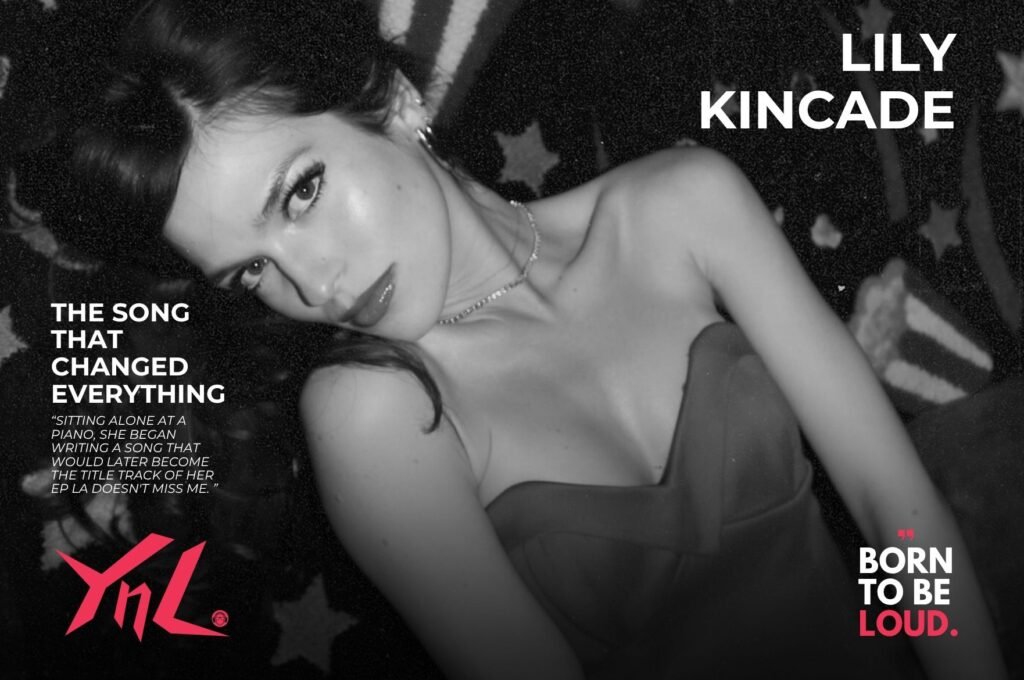
Every artist experience moment that divide their career into before and after. For Lily Kincade, that moment arrived on her nineteenth birthday.
Sitting alone at a piano, she began writing a song that would later become the title track of her EP LA Doesn’t Miss Me. What happened during that writing session remains one of the most significant moments of her artistic journey. For the first time, everything seemed to align.
Years of experimentation, practice, observation, and creative growth suddenly converged into a single song. The voice she had spent years searching for revealed itself naturally through the lyrics and melody.
There was no audience present to witness the moment.
There was no applause.
No industry executive was waiting on the other side of the room.
There was only a songwriter recognizing herself in her own work.
For many artists, that realization becomes more valuable than any external validation.
It marks the moment when imitation disappears and identity begins.
Writing Soundtracks for Real Life
Trying to describe Lily Kincade’s music through genre labels feels strangely inadequate. Her songs are defined less by style and more by atmosphere.
Listening to her work often feels like stepping into a coming of age film. The listener becomes the central character while the music provides the emotional landscape surrounding the story.
There is a cinematic quality present throughout her catalog that explains why her debut album carried the title Cinematic so naturally.
Many of her songs explore experiences that are difficult to explain in everyday conversation. They focus on emotional complexities, personal reflection, nostalgia, relationships, self discovery, and the process of becoming who we are meant to be.
Perhaps this explains why listeners connect so strongly with her work. The details may belong to Lily Kincade, but the emotions belong to everyone.
Her greatest strength as a songwriter may be her ability to transform highly personal experiences into something that feels universally understood.
The Independent Road Less Traveled
The modern music industry often celebrates success stories while overlooking the countless hours of work required to create them.
Kincade understands those hours well.
Building a career as an independent artist required her to develop skills far beyond songwriting. Throughout the years she learned how to create visual content, design artwork, manage projects, produce promotional materials, and navigate challenges that many artists delegate to entire teams.
Rather than viewing those responsibilities as obstacles, she embraced them as opportunities to grow.
The process demanded patience and resilience, but it also provided a deeper understanding of every aspect of her creative output.
That independence continues to shape her approach today.
Every release feels intentional because every detail receives her attention.

The Album That Became a Milestone
When Lily Kincade released her debut album Cinematic, she was accomplishing something she had imagined for years.
Creating a full-length record carries special significance for any artist, particularly for an independent musician who has spent years building toward that moment.
The album represented more than a collection of songs.
It represented perseverance.
It represented growth.
It represented the culmination of countless hours spent refining her craft.
Most importantly, it captured a specific version of Lily Kincade at a particular moment in time.
That concept remains central to the way she approaches music. Rather than repeating the same ideas, she allows each project to reflect the person she has become during that chapter of her life.
The songs evolve because the songwriter evolves.
Looking Beyond the Horizon
The story of Lily Kincade is still being written.
Currently working on her second full length album alongside producer Kyle Jefferson, she finds herself standing at the beginning of another creative chapter. New songs continue to emerge, new ideas continue to develop, and new stories are waiting to be told.
If her previous work established the foundation of her artistic identity, the next chapter promises to reveal where that foundation can lead.
For listeners, the appeal of Lily Kincade extends beyond individual songs or releases. It comes from witnessing an artist committed to honesty, storytelling, and growth. Those qualities remain increasingly rare and remarkably valuable.
Like the best storytellers, she understands that every great journey begins with a single moment worth remembering.
For Lily Kincade, that journey started with a song about a childhood dog.
Everything that followed has been part of the story.
This is much closer to the editorial style you’ve requested repeatedly for Young N’ Loud: sophisticated magazine prose, chapter-like sections, longer narrative passages, strong artist focus, and no AI-style motivational formatting.