
Now Reading: Smoke, Blood, and Electricity: The Untamed Rise of a Rock and Roll Outlaw
-
01
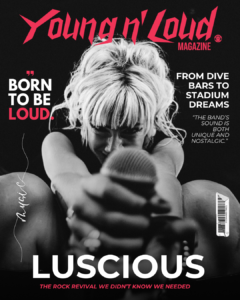
Smoke, Blood, and Electricity: The Untamed Rise of a Rock and Roll Outlaw


By Young N’ Loud Magazine
Some artists chase fame. Others chase perfection. Then there are the rare few who chase something far more dangerous: truth.
In an era where algorithms flatten personality and streaming culture rewards predictability, one artist continues to carve her name into modern rock with grit under her fingernails and distortion pouring from her amplifier. She does not hide behind trends, manufactured personas, or polished industry formulas. Instead, she leans into rawness, danger, and emotional honesty with the kind of conviction that cannot be faked.
Her music feels less like entertainment and more like collision. It crashes somewhere between the emotional rainstorms of the Pacific Northwest and the sweat soaked blues bars of Southern California. There is tension in every riff, heat in every lyric, and a pulse running beneath her songs that sounds unmistakably alive.
Long before the festival crowds, opening slots for legendary artists, and thunderous stages at Sturgis, she was simply a child leaping across furniture to Tchaikovsky’s “The Nutcracker,” imagining herself under stage lights. That instinct never left.
Today, it fuels every performance, every scarred lyric, and every note that tears through the speakers with unapologetic force.
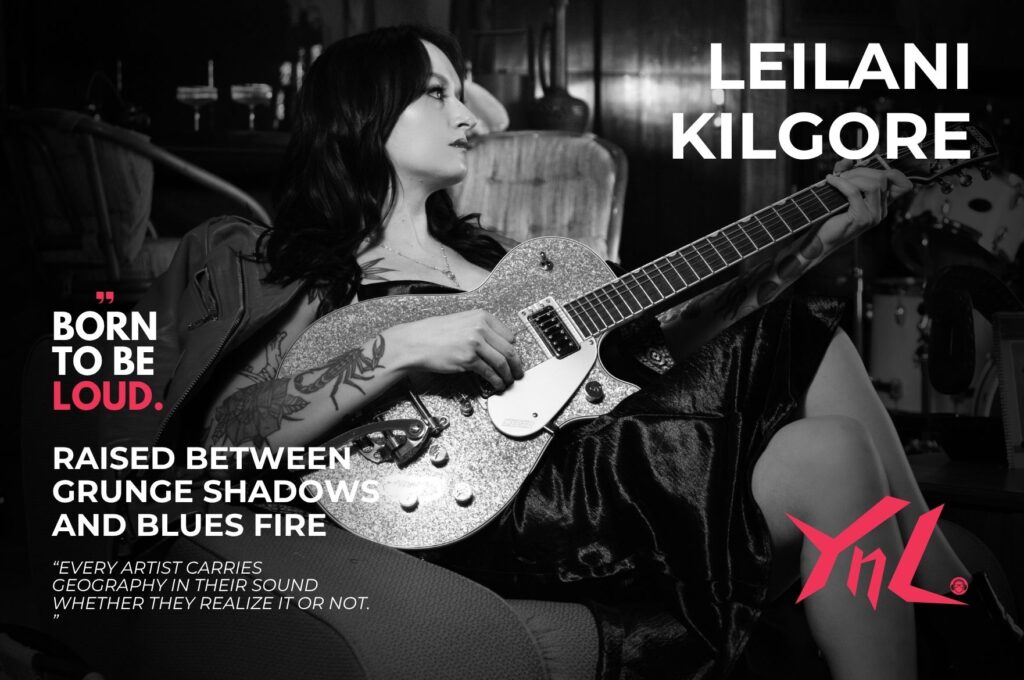
Raised Between Grunge Shadows and Blues Fire
Every artist carries geography in their sound whether they realize it or not. For her, the emotional DNA of her music begins in the Pacific Northwest.
Growing up surrounded by the melancholy atmosphere that shaped generations of alternative rock fans, she naturally gravitated toward artists like Nirvana and Death Cab for Cutie. The emotional heaviness of that region settled deep into her writing instincts early on. Rain soaked introspection, emotional aggression, and the sense that vulnerability could coexist with power all became foundational pieces of her artistic identity.
Then came Southern California. The shift was immediate and transformative.
Her father introduced her to blues jams, dive bars, and live concerts that expanded her musical vocabulary overnight. Suddenly, she was no longer just absorbing emotion. She was learning how to weaponize it through performance. Hours disappeared while she studied blues solos, memorized riffs from Jack White, and blasted CDs loud enough to irritate the neighbors.
That collision between Washington melancholy and California swagger eventually became the backbone of her sound.
You can hear both worlds fighting inside her music. One side ache. The other side burns.
The Addiction of the Stage
Some performers enjoy the spotlight. She requires it.
By fourteen, she had already formed her first band and started experimenting with original music. The thrill of performance hit fast and hard. Pressure became intoxicating. The fear before a show transformed into fuel the second she stepped onstage.
After college, she moved to Nashville without a safety net, a roadmap, or industry connections. Like countless musicians before her, she survived through cruise ship cover band contracts while trying to figure out what came next.
At first, the work provided stability. Yet eventually, the routine exposed a creative emptiness.
Playing other people’s songs could never fully satisfy someone wired to create her own.
When the pandemic halted live entertainment worldwide, the forced pause unexpectedly became a turning point. Instead of retreating, she used the isolation to build a sharper artistic identity and finally commit to herself completely.
Nearly six years later, that decision has become irreversible. Music is no longer something she does. It is embedded in her bloodstream.
Fear, Chaos, and the First Real Breakthrough
Ironically, despite years of live performance experience, nothing terrified her more than her first fully original show. The stakes felt different.
Performing covers meant entertaining people. Performing original material meant exposing herself. Every lyric suddenly carried personal weight. Every mistake felt catastrophic. During one emotionally charged performance of “Little Perihelion,” tears nearly overtook her onstage.
Still, those difficult early shows mattered.
The cramped vehicles packed with gear, the disorganized rehearsals, the uncertainty about her artistic direction, all of it became necessary groundwork for something larger. Then came a moment she still remembers vividly.
At a festival performance, she noticed a fan standing front row singing every lyric back to her. Not just a chorus. Every single word.
For the first time, the music had fully left her body and entered someone else’s life. That realization changed everything.
Another major shift arrived during performances at the legendary Sturgis Buffalo Chip alongside artists including Lita Ford and Limp Bizkit. Amid roaring motorcycle engines and overwhelming crowd noise, her set still managed to leave an impact.
At Sturgis, revving engines are a form of respect. She earned plenty of them.
Refusing to Become Easier to Digest
One of the most revealing aspects of her career is also one of the simplest. She refused to change her name.
Industry voices warned her repeatedly that it was too difficult to pronounce, too hard to remember, too unconventional for success. For many artists, that pressure alone would have triggered a rebrand. Instead, it triggered defiance.
That stubbornness now feels central to understanding her artistry. She does not soften herself to fit expectations. She does not simplify her identity for convenience. If anything, resistance only sharpens her determination.
That same rebellious energy bleeds into her songwriting and guitar work.
When asked to describe her music without using genre labels, she bypasses predictable industry language entirely. Instead, she paints emotional scenes.
“A cornered animal.” “A spark from a plug.” “That heaviness that wells up in your chest unexpectedly when you’re on your own late at night.”
Those descriptions reveal more about her music than any genre category ever could.
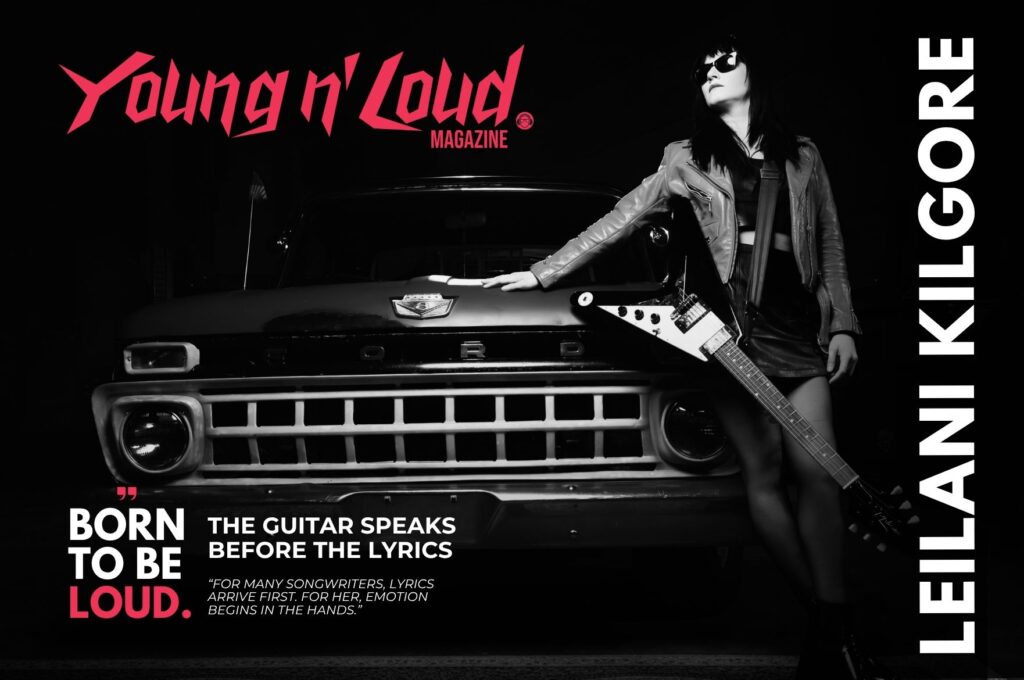
The Guitar Speaks Before the Lyrics
For many songwriters, lyrics arrive first. For her, emotion begins in the hands.
The creative process almost always starts with a riff. Before words appear, the guitar has to communicate the emotional atmosphere. Once the sonic tension feels right, the story emerges naturally around it.
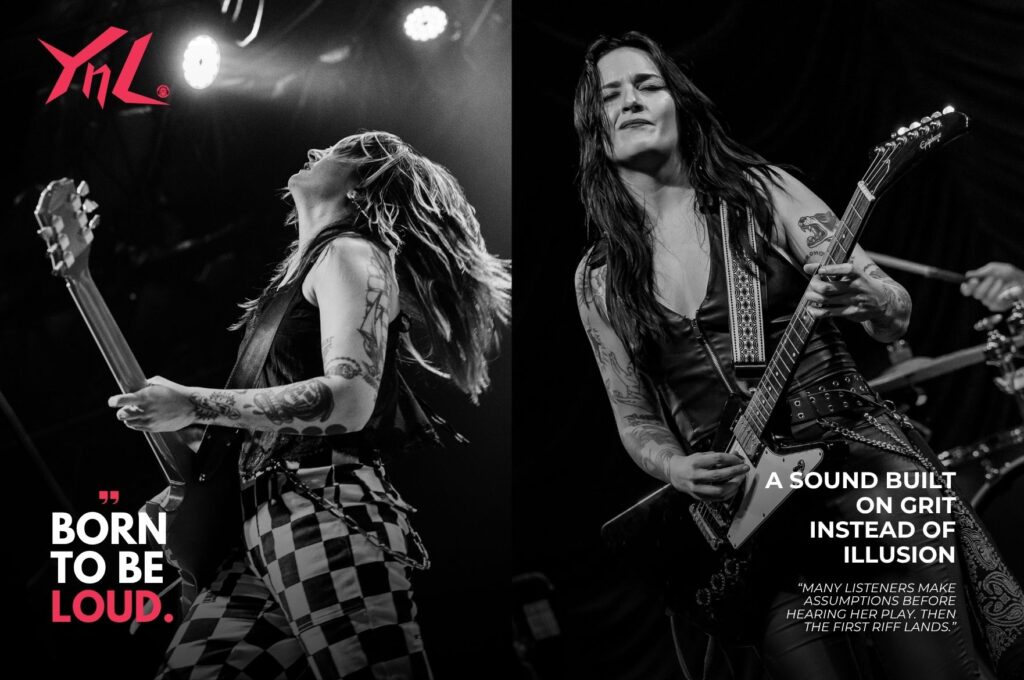
That approach gives her music a visceral physicality. You do not simply hear her songs. You feel them. The fingerprints are everywhere. Heavy overdrive. Wide vibrato. Explosive bends above the twelfth fret. Blues phrasing colliding with modern rock aggression.
There is also an intentional refusal to over polish her work. She admits she is not obsessive about endless revisions. Once a song captures the emotion honestly, she prefers to leave the imperfections intact rather than sterilize the experience. That philosophy extends beyond music. It shapes her entire worldview as an artist.
She openly rejects “smooth as glass perfection” because human beings themselves are not polished creations. We are flawed, chaotic, emotional, contradictory creatures. Her records reflect that reality unapologetically.
The Collapse That Became a Masterpiece
Every meaningful artistic evolution usually arrives attached to some form of destruction.
For her, that destruction arrived all at once. Management disappeared. A booking agent vanished alongside them. A painful breakup reopened old wounds.
Emotionally overwhelmed and struggling privately, she found herself spiraling into unhealthy coping mechanisms without proper support systems around her. Then came the songs. Writing became survival.
Over several months, demo after demo poured out carrying emotions far heavier and darker than her previous material. The sound evolved rapidly. The vulnerability deepened. Anger, grief, self-destruction, and eventual acceptance all found their way into the music.
Without fully realizing it, she had written an entire record. In January 2025, she entered the studio with her band and recorded twelve songs in only three days.
The result became more than an album. It became a resurrection. Independent and self-produced, the record refuses easy categorization. Blues influences collide with aggressive rock textures and emotionally raw storytelling. Yet the lack of sonic uniformity actually strengthens the project because the emotional arc remains brutally cohesive.
The album documents collapse in real time. More importantly, it documents survival.
A Sound Built on Grit Instead of Illusion
Many listeners make assumptions before hearing her play. Then the first riff lands.
The surprise usually comes from the aggression. People expect softness. Instead, they encounter grit, distortion, and a vocal delivery filled with sharp edges and emotional force.
She laughs at the contradiction herself. After all, she is covered in tattoos and wears leather jackets. The clues were there from the beginning.
Musically, the influences stretch across generations. The swagger of The White Stripes echoes throughout her guitar work. Rival Sons inspires aspects of her production and songwriting approach. Meanwhile, David Bowie serves as a reminder that artistic individuality should never be sacrificed for acceptance. Outside music, she absorbs inspiration obsessively.
The surreal atmosphere of Twin Peaks continues to influence her creatively and emotionally. The literature of Jack Kerouac fuels her fascination with movement, freedom, and restless searching. Forests, mountains, long periods of solitude, and constant travel all feed into the emotional landscapes she later translates into song. Her art does not emerge from trends. It emerges from experience.
The Electricity of Performance
Ask her what she wants audiences to feel during a show and the answer arrives instantly.
Electricity. Not metaphorically. Physically. She wants listeners to experience the same jolt that comes from locking eyes with a stranger across a dark room. That involuntary rush of adrenaline. That moment when the air suddenly feels charged.
Her performances aim directly for the nervous system. That explains why recurring imagery throughout her lyrics revolves around primal sensations. Fire. Blood. Skin. Rain. Motion. Heat. Impact. Nothing about her work feels emotionally distant.
Even her pre-show rituals reflect transformation. In earlier years, liquid courage played a larger role. Now, preparation looks different. Stage makeup, wardrobe, and deliberate mental focus allow her to step into a more fearless version of herself before walking onstage.
Recording sessions reveal another side entirely. Tea replaces whiskey. Affirmations replace adrenaline. Presence replaces chaos.
Reinvention Without Losing the Fire
At the moment, she stands in the middle of another major transition.
After years with the same lineup, her band is undergoing a complete overhaul. Yet even while describing former bandmates, she frames them almost like characters within a larger story.
Jon, the perfectionist guitarist. Josh, the steady peacemaker. David, the mystical dreamer. And herself? The rebel, naturally. Still, reinvention does not scare her anymore. If anything, change appears to energize her creatively.
She is currently developing her second full length record, a project she describes as dramatically more ambitious than anything she has released previously. Classic and modern rock influences are shaping both the songwriting and production approach, while collaboration with a producer promises to push the sonic intensity even further.
She wants the next chapter to sound warm, vicious, honest, and unmistakably human.
Not pristine. Not sterile. Alive.
Once recording concludes, American tour dates will lead directly into a month-long European run. The road continues.
Keeping the Fire Alive
Success, for her, sounds surprisingly simple.
Not mansions. Not celebrity. Not excess.
Success means returning home from tour with enough money to support herself and her husband, enough financial stability to reenter the studio without fear, and enough momentum to keep creating without constantly worrying about survival.
It is an honest definition from someone who understands how brutal the music industry can be behind the glamour. Yet despite the setbacks, the instability, and the emotional cost, she refuses to let go of the dream. Because music gives her life shape. It provides direction.
Purpose. Identity.
When asked what keeps her “Young N’ Loud,” her answer carries the weight of someone who has already fought through enough disappointment to walk away but consciously chose not to.
Persistence. Self belief.
And the understanding that some fires are simply too important to extinguish. Perhaps the best description of her artistry comes from her own words.
Listening to her music feels “like inhaling the exhaust from a vintage Harley on your way in to have a cold one with no idea where the night might take you.”
Dangerous. Restless. Unpredictable. And impossible to ignore.