
Now Reading: Music Disease: When Silence Finds a Voice Behind the Mask
-
01
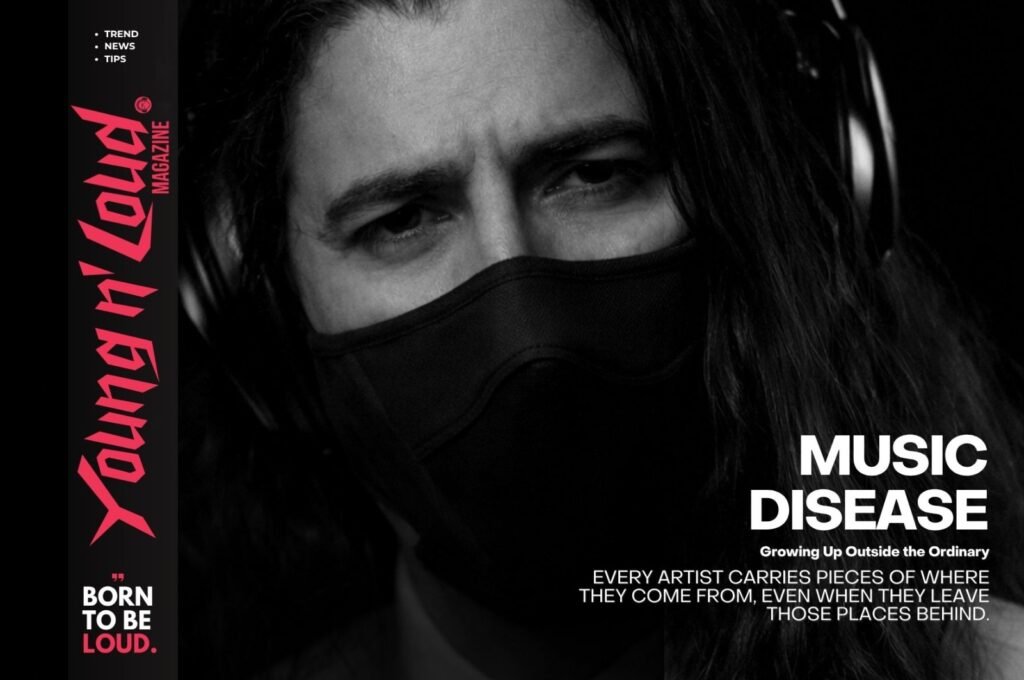
Music Disease: When Silence Finds a Voice Behind the Mask


Article by Young N’ Loud magazine
Some artists write songs to entertain. Others write to remember. But for the artist behind Music Disease, music serves an entirely different purpose, it is survival.
Before there was a mask, before there was a persona, there was a silence too heavy to carry. Certain emotions felt impossible to explain, and some wounds refused to become words. Rather than allowing those feelings to remain trapped inside, they evolved into something unexpected. They became a character, a voice, and eventually an entire artistic universe.
Music Disease was never created as a marketing concept or an alter ego. It emerged from necessity. It became the only place where emotions could exist freely without exposing the person behind them.
And in doing so, the mask began telling truths that the face never could.
Growing Up Outside the Ordinary
Every artist carries pieces of where they come from, even when they leave those places behind.
Now living as an expatriate in a multicultural city filled with diverse influences and a thriving local metal community, Music Disease enjoys an environment where individuality is welcomed. Yet the mindset that fuels the project was shaped somewhere very different.
Growing up, being different often meant standing apart rather than fitting in. Heavy music wasn’t always understood, and choosing an unconventional path came with its own challenges. That contrast became fuel instead of limitation, encouraging a creative direction that refused to conform.
Rather than following trends, Music Disease embraced the feeling of existing just outside the expected.
That perspective still echoes throughout every composition today.
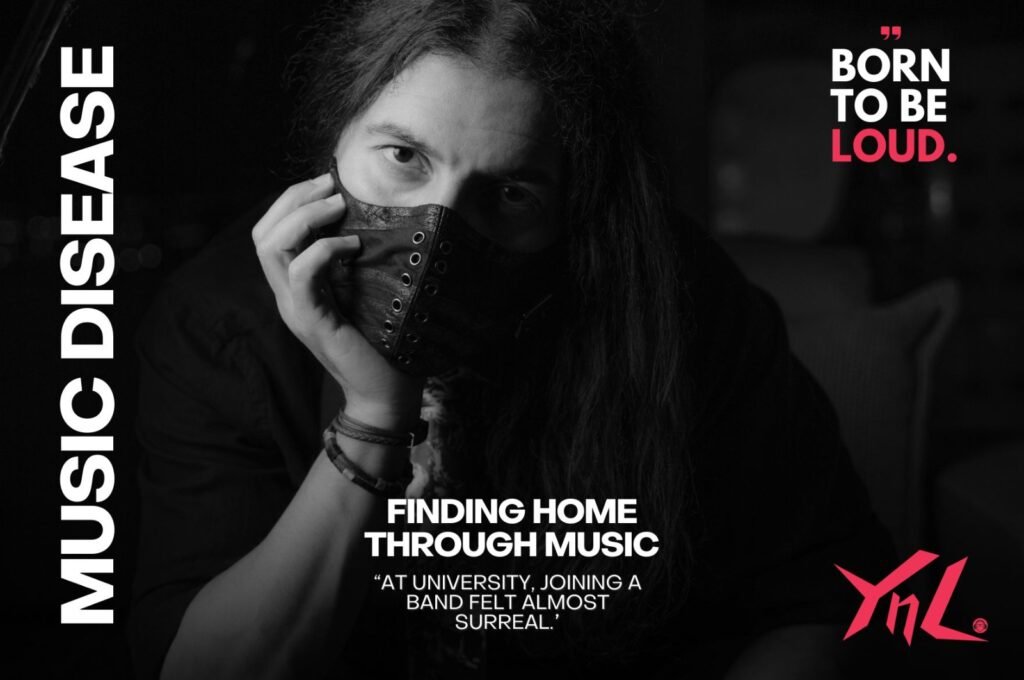
Finding Home Through Music
Long before the solo project existed, there was another defining chapter.
At university, joining a band felt almost surreal. Suddenly, there were endless rehearsals, late-night jam sessions, recording experiments, and conversations about dreams that seemed larger than life.
Those early days weren’t about perfection. They were about belonging.
It was during those moments that music stopped feeling like a hobby and became something much deeper, a place where identity could finally exist without explanation.
That realization has never disappeared.
More Than a Name A Diagnosis
The title Music Disease carries a meaning that goes far beyond branding.
To its creator, it isn’t simply a stage name. It’s a diagnosis.
Music isn’t viewed as a profession or pastime. It behaves more like an infection—one that consumes thoughts, reshapes emotions, and transforms pain into sound.
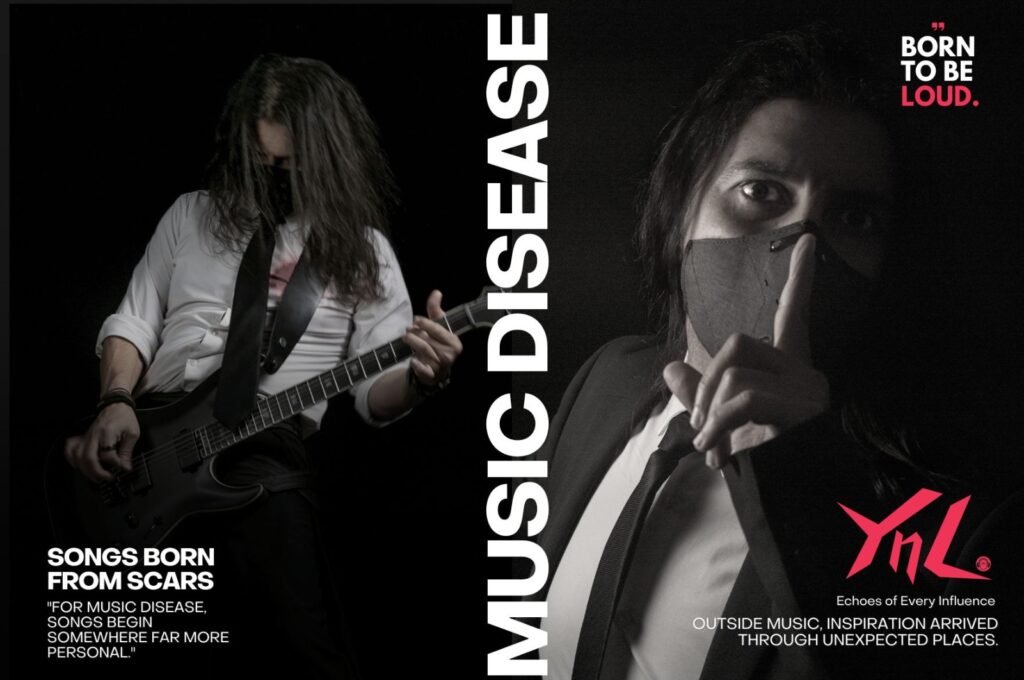
The mask, the carefully designed suit, the haunting vocal expressions, and even the symbolic scar worn across the chest are all manifestations of that condition.
They are not costumes. They are symptoms.
The Sound of Pressure Becoming Art
Trying to define Music Disease through traditional genre labels almost misses the point entirely.
The music feels cinematic, emotionally charged, and constantly balancing vulnerability with danger.
It resembles the rhythm of a heartbeat under pressure, the kind of tension that exists when someone stands dangerously close to emotions they’ve spent years avoiding.
Instead of chasing complexity for its own sake, every song pursues something far more human.
Recognition.
The hope is that listeners hear a melody, a scream, or a whisper and quietly think:
“I’ve felt this before.”
Not because the artist tells them what to feel.
But because the music reminds them of emotions they’ve never spoken aloud.
Whether those emotions are empathy toward oneself, anger, heartbreak, or release, Music Disease believes that acknowledging them is often the first step toward healing.
Songs Born From Scars
For many musicians, inspiration begins with an idea.
For Music Disease, songs begin somewhere far more personal.
They begin with wounds.
Life experiences, emotional repetition, heartbreak, and internal conflict slowly evolve into melodies. Sometimes everything starts with a single tone, only growing as familiar emotions continue resurfacing throughout life.
Each composition becomes another chapter in an ongoing emotional conversation.
Rather than escaping difficult experiences, Music Disease transforms them into something listeners can inhabit themselves.
Echoes of Every Influence
Every artist is built from countless influences, and Music Disease’s creative foundation stretches across decades of music, film, and imagination.
Childhood admiration for Michael Jackson and Bryan Adams eventually evolved into discovering Kurt Cobain, whose music inspired the first songs ever covered.
Soon came Metallica, The Cranberries, and the explosive emergence of Nu Metal through bands like Korn, System of a Down, Coal Chamber, and Slipknot. The emotional power of Amy Lee also left a lasting impression, demonstrating that vulnerability could be just as powerful as aggression.
Outside music, inspiration arrived through unexpected places.
The childhood hero Kabamaru introduced an early fascination with mysterious characters, while horror films, science fiction, and revenge classics especially The Crow helped shape the darker mythology surrounding Music Disease today.
Yet despite these influences, the project has never sought to imitate anyone.
Instead, it has slowly constructed a world that feels entirely its own.
One Person, One Vision
Although the visual identity suggests something larger, Music Disease is entirely a solo creation.
Every song.
Every arrangement.
Every recording.
Every mix.
Every visual concept.
Every creative decision.
Everything comes from one individual.
That complete artistic control allows every piece of the project to remain connected to its emotional core without compromise.
It’s less about managing a band and more about building an immersive experience where music, visuals, symbolism, and storytelling exist as one.
The Mask That People Remember
One of the most surprising moments in Music Disease’s journey came with a simple realization.
People connected more deeply with the persona than with the individual behind it.
Rather than feeling disappointed, that discovery became transformative.
The mask was never intended to hide. Instead, it became a mirror.
Listeners weren’t necessarily seeing the artist, they were seeing reflections of their own emotions.
In many ways, Music Disease had evolved into something larger than personal expression.
It has become a shared emotional language.
Turning Pain Into Purpose
The greatest setback in this journey also became its beginning.
Instead of allowing struggle to destroy creativity, it became the force that gave Music Disease life.
Years spent learning instruments, recording music, experimenting with digital production, investing in equipment, and living through emotionally defining experiences gradually shaped an artistic identity that continues to evolve with every release.
Even moments outside traditional music have left lasting marks.
Watching Cirque du Soleil for the first time remains one of those unforgettable experiences proof that atmosphere, emotion, and storytelling can completely transform an audience without relying solely on words.
That lesson continues influencing the project’s growing mythology.
Behind the Persona
Despite the mysterious appearance, the person behind Music Disease describes themselves as calm and approachable.
Ironically, the quiet nature that exists offstage often creates misunderstandings.
Some assume seriousness. Others mistake silence for arrogance.
Yet those impressions rarely survive an actual conversation.
Another fascinating part of the experience has been watching how differently people respond to the artist compared to the masked persona often without realizing they are interacting with the same individual.
The distinction has become an unexpected social experiment, revealing how appearance can completely reshape perception.
Before recording or creating, however, one ritual remains unchanged. A quiet mention of God. A simple moment of hope before beginning whatever comes next.
A World Painted in Grayscale
If Music Disease had a color palette, it wouldn’t be vibrant. It would exist entirely in grayscale.
Not because color lacks beauty, but because absence can often communicate emotions more honestly than brightness ever could.
That monochrome world reflects heartbreak, introspection, isolation, and the emotional landscape from which every song emerges.
Broken hearts remain the recurring theme throughout the music not as an obsession with sadness, but as an honest acknowledgment of experiences that shape us all.
Expression Over Legacy
Music Disease isn’t interested in chasing fame or building monuments.
Legacy isn’t the destination. Expression is.
The goal is beautifully simple: to help listeners release emotions through music the same way its creator does.
If someone hears a song and feels understood even for a few moments then the project has accomplished exactly what it set out to do.
And perhaps one day, when those emotions finally find peace, the disease itself will disappear.
The mask will dissolve. Until then, the music continues.
The Next Chapter
The world of Music Disease is only beginning to unfold.
New music is already in development alongside new visuals and an expanding mythology that promises to push beyond traditional songs into a richer artistic universe.
Future collaborations remain possible, though only with artists who understand the quiet power of shadows, mystery, and emotional storytelling.
Success isn’t measured through numbers, awards, or charts.
It arrives in a single moment. When one listener presses play…
…and feels seen.
Young N’ Loud Final Thoughts
Some artists create music to be heard. Music Disease creates music to be felt.
Every scream, every haunting melody, every grayscale image, and every carefully hidden emotion serves a greater purpose: giving listeners permission to confront feelings they may have buried for years. Behind the mask isn’t someone pretending to be someone else, it’s someone revealing truths that words alone could never express.
As Music Disease continues building its mythology through music, visuals, and storytelling, one thing remains unmistakably clear. This isn’t simply a solo project or a collection of songs. It’s an emotional world where pain becomes art, silence becomes sound, and vulnerability becomes strength.
For anyone searching for music that speaks beyond language, Music Disease offers exactly what its creator promised from the beginning: a disorder of emotions that mutates into moans, screams, and a mask.