
Now Reading: Rh0da The Art of Feminine Rage and the Sound of Fearless Becoming
-
01
Rh0da The Art of Feminine Rage and the Sound of Fearless Becoming


By Young N’ Loud Editorial Team
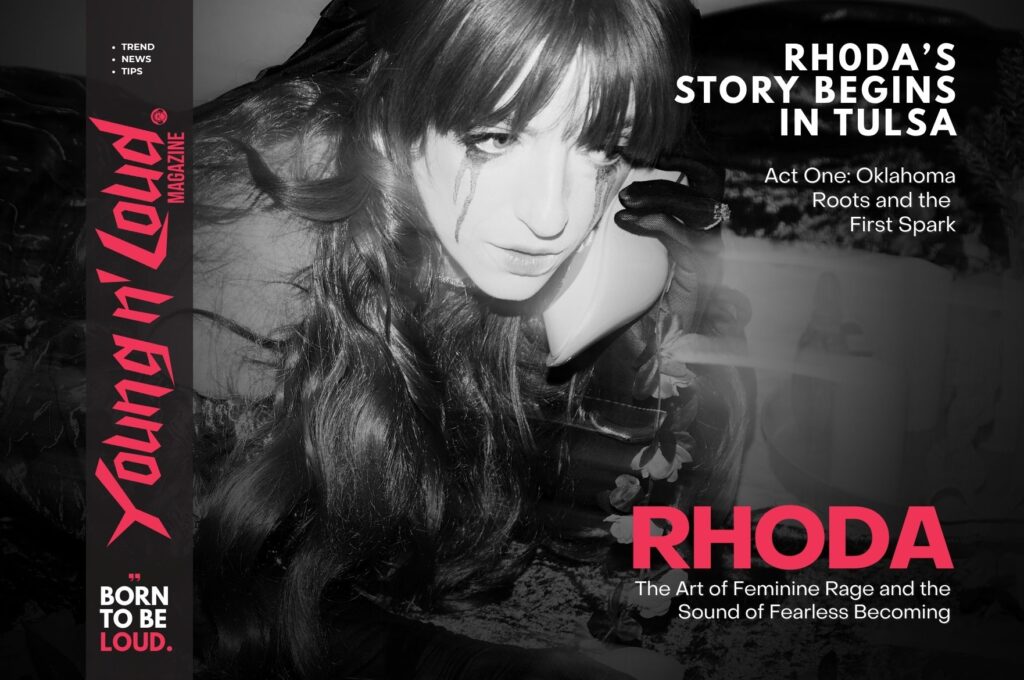
In an industry obsessed with numbers, algorithms, and overnight virality, RH0DA stands as something far more deliberate. She does not chase moments. She builds them. She does not perform anger for spectacle. She distills it into art. What emerges is not simply pop music. It is a thesis on feminine power, theatrical instinct, and sonic confrontation.
Behind the name RH0DA lives a performer who trained on stages long before she ever stepped into a recording studio. Her journey stretches from Tulsa, Oklahoma to New York City, from theater lights to bass driven anthems, from heavy rock bands to a fully realized pop identity that refuses to apologize for its volume.
This is not a story about statistics. It is a story about formation, fire, and a voice that refuses to shrink.
Act One: Oklahoma Roots and the First Spark
RH0DA’s story begins in Tulsa, Oklahoma, where performance entered her life before most children learn multiplication tables. At seven years old, she began taking singing lessons. Meanwhile, she immersed herself in theater, following closely in the footsteps of her older sister. While many children experimented with hobbies, she locked onto a calling.
Growing up in what she calls the Buckle of the Bible Belt shaped her perspective in complex ways. On one hand, she witnessed rigid cultural structures. On the other hand, her liberal parents encouraged her to question everything around her. Consequently, she learned early how to challenge narratives instead of absorbing them. That tension between tradition and rebellion later found its way into her music.
At nine years old, she asked a high school college counselor for brochures from New York University, Juilliard, and Columbia. She did not drift toward New York by accident. She targeted it. She envisioned it. She moved there at eighteen to study acting at NYU, carrying not only ambition but also a sharpened instinct for storytelling.
The stage taught her discipline. However, New York taught her scale. Surrounded by constant art, noise, and urgency, she discovered something deeper than performance. She discovered authorship.
Becoming RH0DA: A Name, A Character, A Philosophy
The name RH0DA does not exist for branding convenience. It comes from obsession. As a child, she became captivated by the 1956 psychological thriller The Bad Seed, specifically the character Rhoda Penmark, a seemingly perfect little girl with a terrifying interior. While other children dressed as princesses, she dressed as RH0DA. The duality fascinated her. Perfection on the surface. Chaos underneath.
To her, RH0DA represents fearlessness. Power. Drive. A willingness to disturb comfort. Although she never played the role in the original play, she performed a parody version in the musical Ruthless! at age twelve. That production gave her not only a role but also a formative creative relationship with a drag performer who played her grandmother and became a kind of artistic guardian. In Oklahoma, that experience felt radical. It expanded her understanding of performance as transformation and defiance. Today, RH0DA functions less as an alter ego and more as amplification. It is the embodiment of everything she refuses to mute.
From Rock Stages to Pop Precision
Before RH0DA solidified into a pop force, she fronted a heavy rock band in New York City. She later formed Briana Layon and The Boys and joined The Nuclears, a band that reshaped her confidence in profound ways.
In The Nuclears, she found creative safety. As a woman playing instruments in rock spaces, she often faced dismissal and condescension. However, within that band, her talent received validation instead of skepticism. Her bandmates respected her voice, both literally and creatively. That foundation proved crucial.
Because of that support, she dared to pivot. While many critics romanticize rock as authentic and dismiss pop as manufactured, RH0DA dismantles that narrative through practice. Pop demands precision. Pop demands structure. Pop demands intentionality. When she transitioned into pop music, she did not simplify her artistry. She intensified it.
She began collaborating with songwriter TJ Rosenthal, who discovered her voice and reached out with songs that felt aligned. From there, the partnership expanded. She brought her own material to the table. Together, they refined it.
Soon after, producer Chew Fu helped shape her first three RH0DA recordings. For the first time, she heard her ideas fully realized. Her closest friends listened and responded with clarity: This is you. That affirmation marked a turning point.
Sound Without Apology
When asked to describe her music without traditional genre labels, RH0DA answers with striking simplicity: pop music for feminine rage.
Yet that phrase carries layered meaning. Her songs pulse with bass driven foundations influenced by bands like Queens of the Stone Age and The Hives. Meanwhile, her ear for harmonies traces back to hours spent singing along to En Vogue, particularly their album Funky Divas. Furthermore, the lyrical vulnerability she admires in Fiona Apple gave her permission to expose emotional fracture without shame.
She also credits No Doubt for inspiring her to pick up guitar and bass, and she often cites Anne Wilson as a vocal benchmark. In fact, Wilson’s performance of “Stairway to Heaven” at the Kennedy Center Honors left an imprint so powerful that it still gives her chills.
However, influence does not equal imitation. RH0DA integrates these inspirations into a sonic architecture that feels contemporary and confrontational. Recently, she has collaborated with Mexican producer P3CKY, refining an upcoming collection of songs that promise sharper production and expanded scope.
Her signature remains unmistakable. The voice leads. The bass commands. The narrative burns.
The Visual Thesis: LOVED and NOT GONNA
If RH0DA’s recordings establish her sonic identity, her music videos articulate her manifesto.
The videos for “LOVED” and “NOT GONNA” represent defining milestones. Since childhood, she imagined creating high production visual work for her own music. She once watched MTV countdowns and drafted mental blueprints for future videos. Years later, those blueprints materialized.
During the filming of “LOVED,” she watched the monitor and experienced what she calls her “This is it moment”. Everything aligned. The aesthetic, the emotion, the intention. Director Séyla Hossaini immediately understood her concept and translated it visually without dilution.
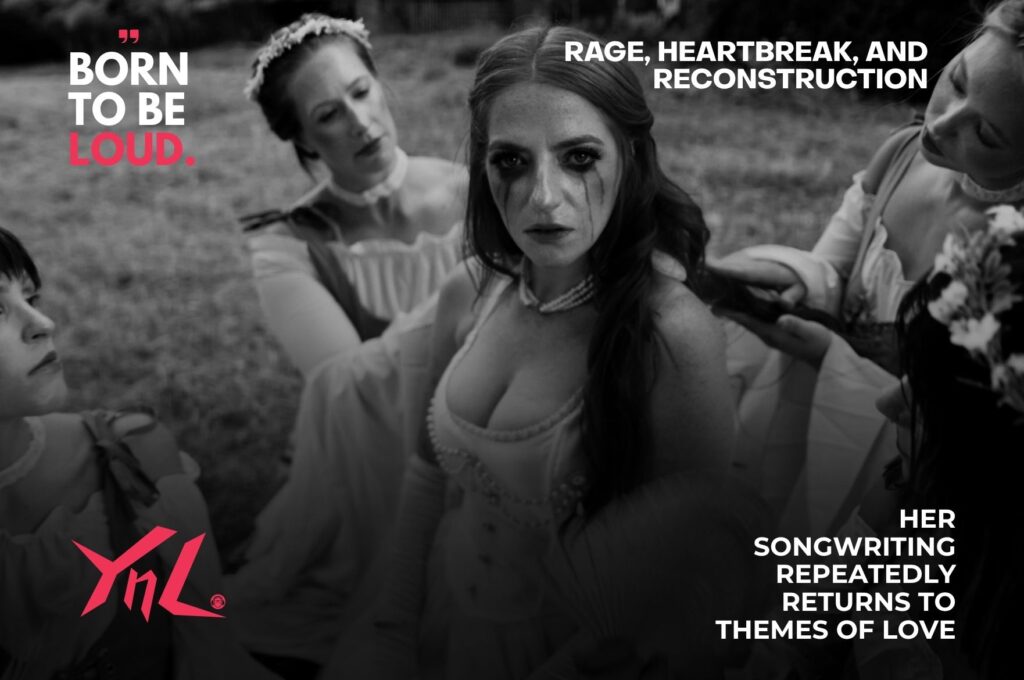
Notably, RH0DA kills at least one man in every music video. The symbolism does not hide. It confronts. It channels frustration with systemic sexism into theatrical catharsis. Rather than soften her critique, she stylizes it. Importantly, this visual aggression never feels random. It operates as narrative punctuation.
Creation as Collaboration
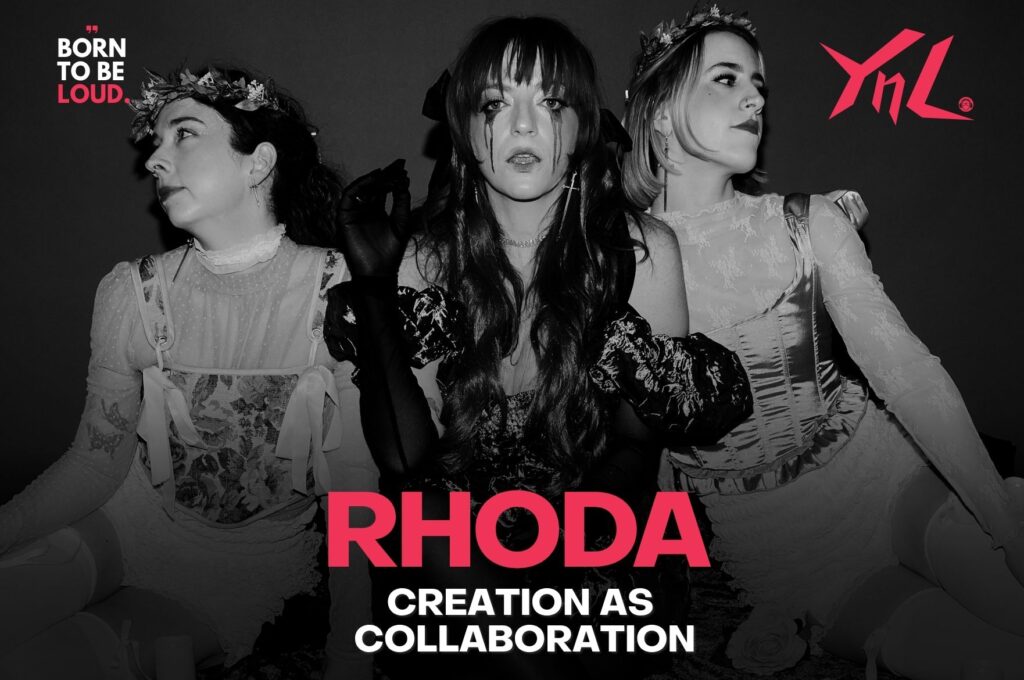
Although RH0DA’s persona radiates autonomy, she builds her world collaboratively. Her process begins with a lyric notebook. She writes constantly. Separately, she crafts vocal riffs, guitar progressions, and increasingly, bass lines. Once she identifies combinations that resonate, she sends them to her producers. From there, ideas evolve through shared experimentation.
Moreover, dancers, directors, and visual artists contribute to the RH0DA ecosystem. Her first full show under the RH0DA name featured choreography, projected visuals, and an integrated stage design she had envisioned for years. That performance confirmed that her artistry extends beyond audio into immersive experience.
Consequently, RH0DA does not operate as a solo act in isolation. She operates as a creative nucleus.
Rage, Heartbreak, and Reconstruction
Every artist faces rupture. For RH0DA, a painful breakup forced confrontation with self abandonment. She realized she had drifted from her core desires. Instead of retreating, she redirected.
She poured the aftermath into writing and recording. She sharpened her focus on what RH0DA should represent. In doing so, she transformed personal devastation into structural clarity.
Her songwriting repeatedly returns to themes of love, heartbreak, and power. However, she expands the term Gurls beyond gender limitation. Gurls, in her lexicon, signals inclusivity and solidarity. It names those who refuse to diminish themselves for anyone.
Beyond the sound, she wants listeners to reclaim energy from what she bluntly calls Shitty Dudes. Whether that manifests as toxic partners, dismissive strangers, or oppressive systems, she urges listeners not to surrender their momentum.
In that sense, her work functions as both release and rallying cry.
Red: The Color of Her Frequency
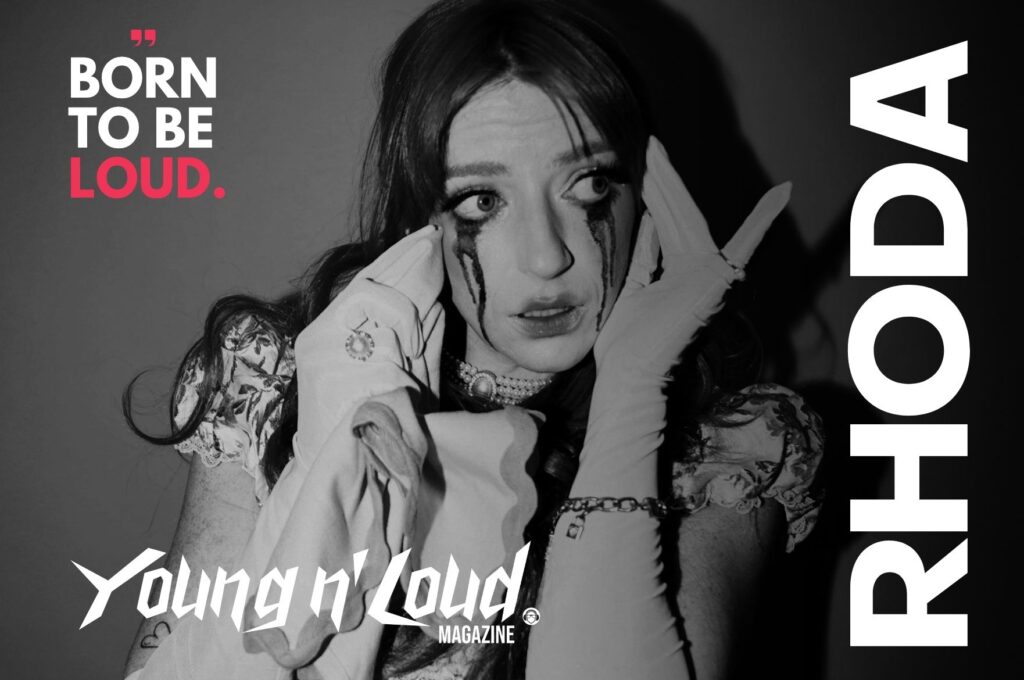
If RH0DA’s music carries a color, she chooses red. Love. Death. Revenge. That triad defines her tonal palette. The songs do not whisper. They declare. Yet within the declarations lives vulnerability shaped by years of theater training and vocal discipline.
Offstage, she grounds herself through family, especially her sister, who critiques her work honestly. She also works with children, a humbling counterweight to performance ego. Before shows, she takes long showers while warming up vocally, then prepares while watching comedy. Recently, she has gravitated toward the television series What We Do in the Shadows, balancing intensity with humor. Ritual keeps her centered. Structure fuels spontaneity.
Defining Success and Looking Forward
For RH0DA, success begins pragmatically. Music costs money. Therefore, sustaining the ability to create and release her own work defines achievement. If audiences connect emotionally, that connection multiplies the victory.
Of course, she envisions sold out venues and global tours. However, she measures progress through autonomy and resonance rather than spectacle alone.
Currently, she prepares four new songs and additional music videos. She describes her artistic thesis as clearer than ever. With each release, she intends to sharpen that clarity.
Dream collaborations remain vivid. She hopes to work with songwriter Justin Tranter, whose writing has shaped contemporary pop for over a decade. She also imagines featuring Patty McCormack, the original Rhoda Penmark, in a future video. Furthermore, she expresses interest in collaborating with South Korean artist BeWhy, drawn to his genre blending grandeur.
Ambition, for her, does not feel abstract. It feels scheduled.
The Sound of Young N’ Loud
What keeps RH0DA young and loud? Community. She thrives on collaboration with dancers, producers, photographers, and directors. Each project introduces new creative chemistry. The older she grows, the more she anticipates that exchange. Curiosity, not youth alone, sustains volume.
If she could send one message into space, she would transmit her song “LOVED,” capturing the rage and release of modern womanhood. Alternatively, she might send a track from Funky Divas because, in her words, outer space deserves some harmonic bops. Ultimately, RH0DA defines herself in one sentence: This is music for feminine rage. Hit play, and you will not find passive background noise. You will find confrontation, theatrical intelligence, bass heavy defiance, and a voice that refuses erasure.
In an era saturated with disposable content, RH0DA constructs something far more enduring. She builds sound as a statement. She builds pop as power. And above all, she builds art that demands to be felt, not merely streamed.