
Now Reading: Indie Basement (3/20): the week in classic indie, alternative and college rock
-
01
Indie Basement (3/20): the week in classic indie, alternative and college rock


Happy spring! In a very busy month, Indie Basement is in the eye of the storm and there are only three reviews this week: Ladytron deliver their danciest album yet; OSEES’ frontman John Dwyer goes pop, kinda, on his first Damaged Bug album in six years; and Anna Calvi teams with Iggy Pop, Matt Berninger, Perfume Genius and Laurie Anderson for an EP of outstanding duets.
This week’s Indie Basement Classic features a surprise Clash reunion.
Over in Notable Releases it’s a much busier week with reviews of Poison the Well, Gladie, Avalon Emerson & the Charm, and more.
On this week’s episode of BV Interviews I talked to MEMORIALS whose great new album is out next week.
On this week’s episode of BV Weekly, we launch a look back at 1996.
Head below for this week’s reviews…
Ladytron – Paradises (Nettwerk)
Ladytron let the ice melt a little for their danciest — and longest — album yet
“There’s an itch we never scratched,” Ladytron’s Daniel Hunt says of this new single and the Liverpool electro vets’ upcoming eighth album. “Despite our origins in the DJ world, we never actually made a ‘disco’ record. Albeit, ‘disco’ in our context has a somewhat different meaning.”
Ladytron have always had an eye on the dancefloor, but they’ve usually played it cool. On Paradises, the band’s eighth album, they loosen up and have some fun, digging into a variety of late-’80s and ’90s dance styles across this 16-track double LP.
You feel the difference most on “Kingdom Undersea,” which adds a little early-’90s baggy/Madchester to the equation — Inspiral Carpets come to mind — and the song’s staccato, housey piano riff almost makes them sound like a different band, at least until Helen Marnie’s distinctive vocals enter. It’s also a rare duet with Hunt, whose ’80s goth-leaning delivery makes for one of the most refreshing and unusual Ladytron singles in years.
There’s a lot of late-’80s / early-’90s acid house DNA on Paradises, too, from the plonky, percussive synths on “I Believe in You,” “Free, Free” and “Death in London” (very A Guy Called Gerald), to the 808 State-style rolling bass and electro handclaps of “I See Red” and “Metaphysica.” Melodically, this is still very much a Ladytron album, but they’re working with a new, more colorful box of crayons.
At 72 minutes, Paradises probably lets the party go on a little too long — this could stand to lose a quarter of its runtime — but Ladytron are clearly having a blast. It’s their party, so who am I to tell them when it’s time to leave?
—

Damaged Bug – Zuzax (Deathgod)
John Dwyer toys with pop on his first Damaged Bug solo album in six years.
John Dwyer is one of the most prolific musicians of the last 20 years, reliably releasing a new album with Oh Sees every year — sometimes more than one — not to mention records by his other groups like Bent Arcana and Chime Oblivion. Damaged Bug, though, is his solo project where he favors synthesizers over guitars, but otherwise doesn’t seem to impose many rules.
ZUZAX is Dwyer’s first Damaged Bug album in six years and his first of original material in nearly a decade (2020’s Bug Out Yonkers was all covers of songs by cult artist Michael Yonkers). The 11 songs here were culled from nearly 40 he’d been sitting on — rare for Dwyer, who usually works much faster — and while he’s said he couldn’t find a unifying thread, musically these all lean toward the lighter, more playful side. Pop, even.
“I feel like it’s every artist’s calling to construct personal messages cloaked in moments of escapism,” Dwyer says. “It’s a bit of a joyous/sad record dealing with hope and forgiveness, two things which I hope end up more in my life.” The joy is apparent right from opener “End of the War,” a ’60s-style dance party jam featuring backing vocals from former Oh Sees member Brigid Dawson. It’s a blast, even if Dwyer’s got heavier things on his mind.
Groove is at the heart of ZUZAX, whether it’s the Jaki Liebezeit-style motorik fills of “Mozzy Rooves & More” and “Sike Witch,” the jazzy beats brushing up against jungle on “Fried Hands,” or the woozy, late-night jams that could easily slip into a trip-hop set. One of the best of those is “Over Exposed,” a cinematic slow dance that nods to doo-wop greats The Flamingos and finds Dwyer, unexpectedly, in full crooner mode. Bathed in the glow of smooth sax, it’s a sound that suits him surprisingly well — and one he could probably explore further. Then again, he may already have another album’s worth of it in the 29 songs still on the shelf.
—

Anna Calvi – Is This All There Is? (Domino)
Terrific EP featuring Iggy Pop, Laurie Anderson, Matt Berninger, and Perfume Genius alongside Anna Calvi’s smoky, confident cool
Anna Calvi should be bigger. In the industry she already is, I guess — a musical polymath, composer, and guitar shredder with a knockout set of pipes. She’s scored two seasons of Peaky Blinders and collaborated with the late avant-garde theatre director and choreographer Robert Wilson on 2017’s stage production The Sandman. But as a rock musician, she deserves a wider audience, and maybe this will be the year.
Is This All There Is? is the first of three upcoming releases that “explore identity as a metamorphosis, shaped and reshaped through the experience of falling in love.” All four songs here are duets of sorts, featuring Iggy Pop, Perfume Genius, Laurie Anderson, and The National’s Matt Berninger. “They’re not trying to please anyone,” Calvi says of her collaborators. “They express exactly who they are.”
The EP opens with a real corker: the Iggy collab “God’s Lonely Man.” The punk icon shows up on a lot of other artists’ records these days, but it’s usually in the form of gravelly spoken word, so it’s a treat to hear him really sing. Calvi has always had a little Siouxsie Sioux in her DNA, and she lets that melodrama fly on this glammy, gothy stomper. She and Iggy sound great together, and it’s almost like he and Siouxsie are joining forces and mixing their own iconic versions of “The Passenger,” just in a brand-new song.
The other standout is the title track with Matt Berninger. Calvi’s voice can blow your hair back, and like Iggy, Berninger’s baritone pairs perfectly with her. This is sweeping, cinematic stuff, with a spaghetti western arrangement that has the two of them galloping off into the horizon.
The EP’s two remaining tracks are covers: Perfume Genius joins for an atmospheric take on Bonnie ‘Prince’ Billy’s “I See a Darkness,” trading lines back and forth, while Laurie Anderson lends her unmistakable presence to a version of Kraftwerk’s “Computer Love,” all robotic cool in shades of “O Superman,” with Calvi adding ghostly vocal textures. It’s good, but compared to the other three songs, it doesn’t quite have the same impact.
Is This All There Is? No, but it’s a strong introduction to Calvi’s deeply saturated romantic world, which includes three albums (start with her excellent 2010 self-titled debut), soundtracks, and — soon — two more EPs.
—
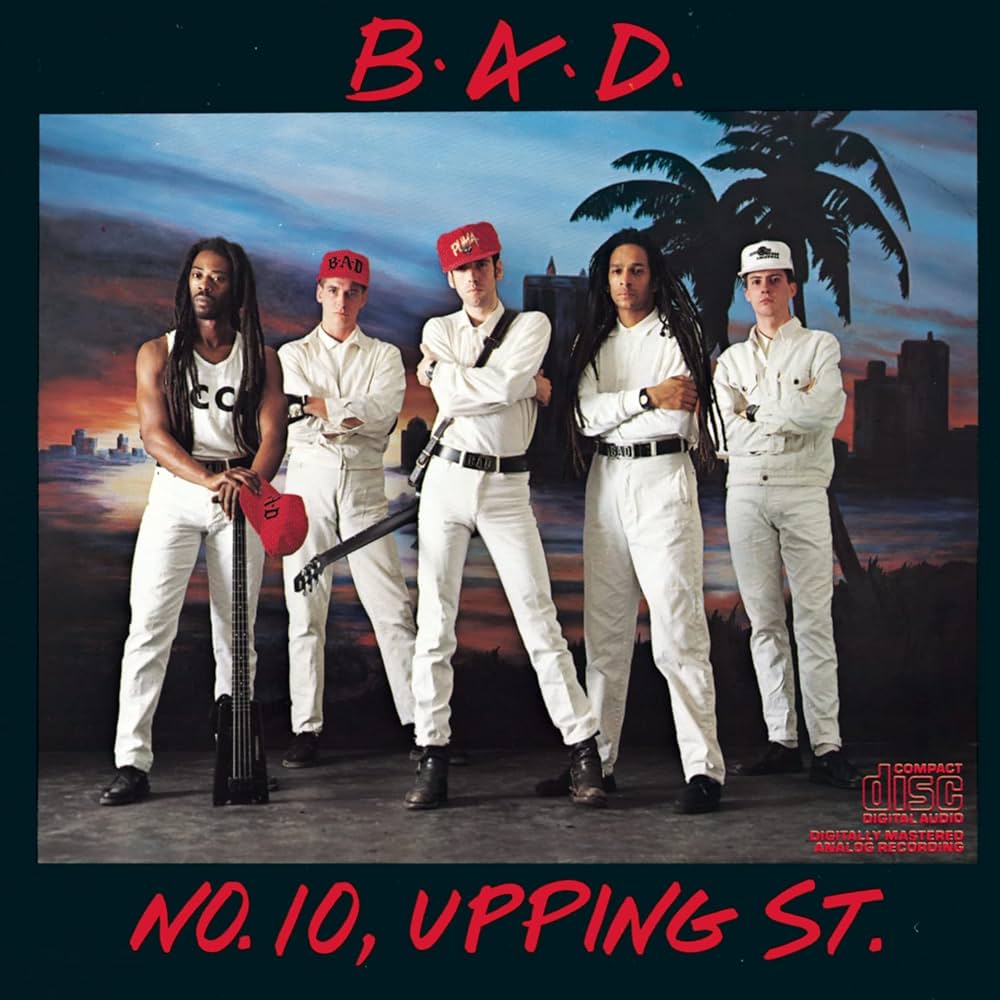
INDIE BASEMENT CLASSIC: Big Audio Dynamite – No. 10, Upping St. (CBS, 1986)
The Clash’s Mick Jones reunited with Joe Strummer on Big Audio Dynamite’s second, and best, album
Like a lot of great bands, The Clash fell apart messily. After the release of their breakthrough Combat Rock, there was bad blood and dark clouds everywhere, with two factions emerging: frontman/guitarist Joe Strummer and bassist Paul Simonon wanted to steer things back toward punk, while guitarist/singer Mick Jones was increasingly drawn to the rap and dance music coming out of New York. (Drummers Topper Headon and Terry Chimes were left in the middle/out in the cold.) In the fall of 1983, Strummer and Simonon fired Jones — a terrible decision for The Clash, but a great one for Mick.
After a brief stint in supergroup General Public (with members of The Beat, The Specials, and Dexys Midnight Runners), Jones teamed up with filmmaker/DJ Don Letts — the original DJ at London punk club The Roxy and a key visual collaborator for The Clash — to form Big Audio Dynamite. With Letts’ love of film and reggae, plus emerging sampling technology, synthesizers, and drum machines, B.A.D. quickly carved out a sound that felt genuinely new. The lineup was rounded out by bassist Leo “E-Zee Kill” Williams, drummer Greg Roberts, and keyboardist Dan Donovan (who also shot the cover of their 1985 debut, This Is Big Audio Dynamite).
That first album is a classic, fusing rock, hip hop, reggae, and electro into something hugely influential. It also arrived the same week as The Clash’s final album, Cut the Crap — about which the less said the better. But I digress. This is about the follow-up, 1986’s No. 10, Upping Street, which came with a surprise: it was co-produced by Joe Strummer, who also co-wrote five of its nine songs.
B.A.D. were in the groove, Jones was still a hook machine, Letts was coming into his own, and Strummer’s presence added real depth. “C’Mon Every Beatbox” is a call-to-arms banger loaded with TV and movie samples, while “Hollywood Boulevard” is a funky, wicked takedown of tinseltown. There’s also “Ticket,” with Letts on lead vocals, and the simmering rap cut “Sightsee M.C.” The best moments, though, are the quieter ones where Strummer’s influence is most felt: the poignant “Beyond the Pale” and “Sambadrome,” inspired by Rio’s coke-dealing folk-hero Escadinha.
The most unexpected track is “Dial a Hitman,” which starts as a witty satire about assassins for hire before turning into a two-minute phone call after a botched job. The voices are Matt Dillon and Laurence Fishburne — both early in their careers — and it’s all credited to a nonexistent film, Lafayette Zero Six, directed by, wink wink, “Jan Tarmush.”
No. 10, Upping Street is overflowing with ideas and great songs, and while it’s very much of its time, it still holds up. It’s the best album B.A.D.’s original lineup made before their 1990 split following Megatop Phoenix, and one of the strongest records associated with either Mick Jones or Joe Strummer. Their reunion didn’t last, but you can hear flashes of the Clash album that might have been.
—
Looking for more? Browse the Indie Basement archives.
And check out what’s new in our shop.
The 20 Best Britpop Albums of 1995