
Now Reading: From the Haçienda to Number 10: Could Andy Burnham Put Britain’s Music Scene Back on the Political Agenda? –
-
01
From the Haçienda to Number 10: Could Andy Burnham Put Britain’s Music Scene Back on the Political Agenda? –
From the Haçienda to Number 10: Could Andy Burnham Put Britain’s Music Scene Back on the Political Agenda? –

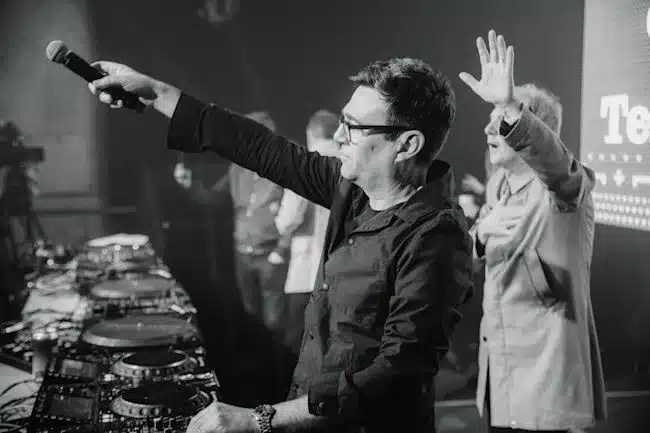
A politician approaching a DJ booth usually creates the same atmospheric dread as watching somebody’s dad invade the dancefloor at a wedding, shoulders twitching through a borrowed approximation of rhythm while every camera in the room waits to preserve the humiliation. Andy Burnham has spent years flitting around Manchester’s music scene without producing that familiar cultural wince. I remember seeing him DJ alongside Clint Boon at Jimmy’s in the Northern Quarter in 2018, where his presence made sense within the fabric of the city, and that evening became one entry in an increasingly convincing musical history.
Since then, Burnham has battled Liverpool City Region mayor Steve Rotheram behind the decks, raised money for homelessness services through music events and spoken about albums with the emotional specificity of somebody whose taste developed through record shops, John Peel broadcasts and formative gigs. He worked in Manchester during the city’s fabled 1989 summer, bought Stone Roses tickets from Piccadilly Records and witnessed their Empress Ballroom show. The Wedding Present, The Pogues, New Order, The Smiths and The Strokes sit within his personal canon.
Now, astonishingly, that lifelong music fan has stepped into Number 10, replacing a stiff pork skin sack whose level of empathy and sincerity when addressing austerity matched that of a Dalek in a supermarket. The fever dream has reached Downing Street, carrying the possibility that British music may finally have an ally who understands its value from both sides of the barrier.
A Political Relationship with Music That Predates the Photo Opportunity
Westminster has spent decades treating popular music as an accessory retrieved whenever somebody needs to appear human. Gordon Brown once professed his appreciation for Arctic Monkeys with all the natural warmth of a hostage reading a prepared statement. David Cameron claimed The Smiths while Johnny Marr publicly forbade the association. Tony Blair invited Noel Gallagher into Downing Street and wrapped New Labour in Britpop’s cultural momentum, turning Cool Britannia into an immaculate exercise in political image management before the relationship curdled under war, disillusionment and the dawning realisation that rock stars had provided scenery for somebody else’s ascent.
Jeremy Corbyn’s connection with grime carried greater political substance because artists recognised something useful in his commitment to public services and working people. Grime4Corbyn grew from genuine enthusiasm among younger voters and musicians whose lives had been shaped by austerity. Burnham enters from another direction entirely, with a record collection and gig history woven through decades of his private life, accompanied by an administrative record that treated music as civic infrastructure.
His DJ appearances have also served a purpose beyond personal branding. The Manchester and Liverpool mayoral DJ battle at Depot Mayfield in 2022 raised over £25,000, with proceeds supporting homelessness initiatives; its Liverpool follow-up continued that relationship between music, regional solidarity and material help. Burnham understands that music can gather people around a cause without flattening the evening into a party political broadcast. He enters the room, plays records and trusts the culture to carry the message.
Manchester Became His Evidence Base
Burnham’s mayoral years gave him ample opportunity to trade upon Manchester’s mythology, wheel out a few Factory Records anecdotes and leave the present-day music economy to fend for itself. Instead, he commissioned an independent Greater Manchester Music Review with UK Music in 2019, examining barriers surrounding finance, disability, gender and ethnicity while proposing a regional Music Board, a talent fund, improved transport and stronger planning protection for grassroots venues.
The resulting Greater Manchester Music Commission brought artists, venue representatives, educators and industry figures into civic decision-making. His administration promoted the Agent of Change principle, placing responsibility for soundproofing upon developers whose new projects threaten established venues, and supported practical planning guidance created with Music Venue Trust. These interventions lack the glamour of posing beside a chart star, yet they address the pressure points that determine whether a venue survives another luxury apartment development or receives its death sentence through a noise complaint.
In a bit of a questionable yet well-intentioned move, he appointed Warehouse Project and Parklife cofounder Sacha Lord as Greater Manchester’s first night-time economy adviser in 2018, giving nightlife an advocate inside regional government while Westminster continued speaking about clubs as though they were unruly teenagers awaiting discipline. The Town of Culture programme carried investment and civic attention into Greater Manchester’s boroughs, while the Bee Network connected cultural participation with transport, recognising that an affordable night out still requires a route home.
The £2 Bus Home Matters to Music
The cost-of-living crisis has changed who gets to participate in music, hollowing out audiences while pushing working-class musicians towards exhaustion and exit. Punters calculate the ticket, drinks and journey home, then close the checkout window because an evening costing £15 on paper can rapidly swallow £50.
Burnham’s restored £2 bus fare cap will hardly repair that economic wreckage, yet its relevance reaches deep into the nightly mechanics of cultural life. A predictable fare helps a fan reach a venue in the next town, gives hospitality workers an affordable journey after a shift and allows younger audiences to attend gigs without surrendering a painful portion of their weekly budget to transport. For musicians carrying smaller pieces of equipment, photographers covering local shows and writers travelling to review them, those saved pounds accumulate.
Scrapping VAT on household electricity bills offers another modest release of pressure. Money retained through an energy bill can become rehearsal rent, guitar strings or a gig ticket. The sums will feel small beside years of escalating food costs and frozen tax thresholds, and Burnham still faces demands for measures capable of shifting wealth at the scale the crisis requires. Yet culture depends upon disposable income, and disposable income has been bled from working households until live music has started resembling a luxury service.
There is political meaning in recognising that affordability outside a venue affects everything happening inside it. Starmer approached austerity through spreadsheets, rehearsed concern and the emotional temperature of reinforced concrete. Burnham has begun with interventions people can encounter during an ordinary week, offering an early indication that lived experience may receive a place in government arithmetic.
Breathing Space for the Rooms Where Music Begins
The new 20 per cent business rates cut for pubs, social clubs and eligible live music venues across England, due from April 2027, could benefit almost 32,000 premises, with the typical pub expected to save around £1,100 during the following year. The largest music venues sit outside the scheme, directing support towards community spaces and smaller operators facing the sharpest threat. The government has published the initial details of the measure.
That £1,100 might cover part of an electricity bill, an urgent repair or several staff shifts. It offers breathing space inside a sector where over half of Britain’s grassroots music venues reported zero profit in 2025 and average margins hovered around 2.5 per cent. Survival at that level can depend upon a broken freezer, a licensing dispute or one disastrous month.
The measure remains an opening gesture. Music Venue Trust has called it an encouraging first step while continuing to demand stronger Agent of Change protections and a compulsory levy on arena and stadium tickets to feed money back into the grassroots circuit. Business rates relief cannot resurrect venues already converted into flats, and April 2027 will arrive too late for businesses approaching collapse this winter. Working musicians also need affordable housing, properly funded arts education and protection from an industry increasingly structured around inherited wealth.
Burnham deserves credit for placing live music venues among his first cost-cutting announcements as Prime Minister. He now carries responsibility for following that symbolic choice with structural reform.
Conclusion: Hope Needs to Survive the Encore
A Prime Minister with excellent taste in guitar music provides a pleasing national novelty. A Prime Minister who understands why venues close, why transport determines attendance and why creative careers have become increasingly inaccessible to working-class people could alter the direction of British culture.
Burnham has already proved capable of occupying musical spaces without making everybody clench. His years in Manchester produced policy, consultation and a civic language in which music belonged beside transport and wellbeing. Number 10 now gives him the power to carry those principles across Britain.
The fever dream deserves enjoyment, particularly after the Starmer years reduced hope to another phrase delivered through bloodless managerial syntax. Still, fandom grants Burnham familiarity rather than immunity. The music sector should welcome the £2 journey home and the business rates relief, then demand the compulsory ticket levy, serious grassroots investment and a cultural policy that reaches every town abandoned by Westminster.
Britain has placed a genuine music fan behind the most famous door in politics. The decisive question concerns whether he can keep the doors of its venues open.
Article by Amelia Vandergast