

Now Reading: Corporation for Public Broadcasting Shuts Down Post-Funding Cut
-
01
Corporation for Public Broadcasting Shuts Down Post-Funding Cut


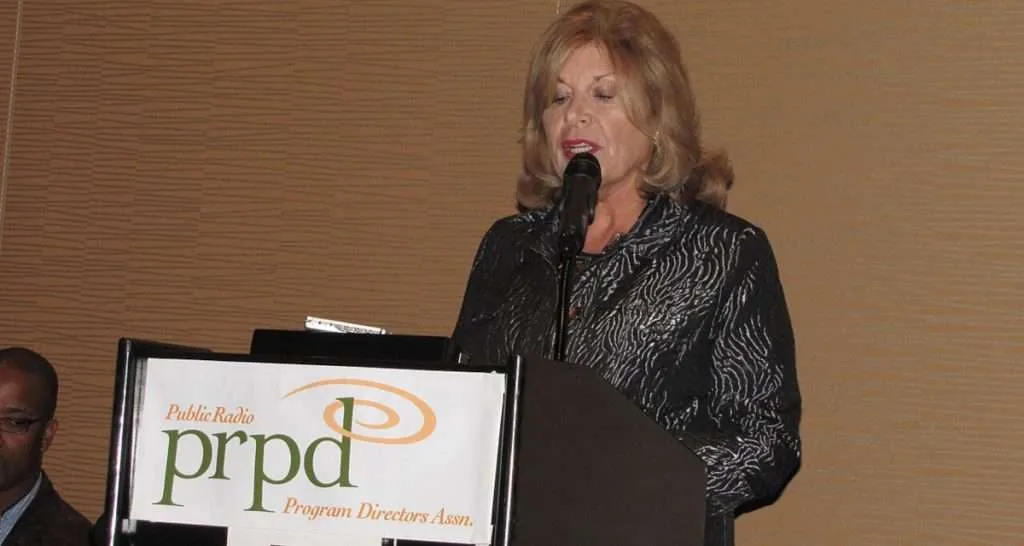
Patricia Harrison, president of the Corporation for Public Broadcasting (CPB). Photo Credit: David Hollis
In keeping with its previously disclosed shutdown plans, the Corporation for Public Broadcasting (CPB) board has officially voted to dissolve the organization.
The CPB confirmed the vote and the resulting dissolution in a brief release this afternoon. Turning back the clock for a moment, July 2025 brought the passage of a rescissions package that, among different things, axed $535 million in annual CPB funding across two years ($1.1 billion total).
Though some have settled for top-level descriptions of the clawed-back capital, it bears clarifying that the CPB was tasked with distributing funds to local public stations via grants. All told – and despite their well-documented pushback – PBS and NPR only received about 15% and 2% of their respective funding from federal grants.
In other words, the cancellation is having the biggest impact on individual stations, many of which are moving to obtain operating capital directly from listeners and viewers.
As for the CPB (which reportedly employed around 100 individuals), the entity’s board in early August announced “an orderly wind-down of its operations.”
Said wind-down, we reported at the time, referred to the layoff of most staff on September 30th (the fiscal year’s end), with a transition team staying aboard into January 2026 “to ensure a responsible and orderly closeout of operations.”
And with the new year as well as the latter deadline having now arrived, CPB president and CEO Patricia Harrison today explained the decision to shut down altogether.
“For more than half a century,” Harrison said of the dissolution, “CPB existed to ensure that all Americans—regardless of geography, income, or background—had access to trusted news, educational programming, and local storytelling.
“When the Administration and Congress rescinded federal funding, our Board faced a profound responsibility: CPB’s final act would be to protect the integrity of the public media system and the democratic values by dissolving, rather than allowing the organization to remain defunded and vulnerable to additional attacks,” concluded Harrison, who spent over 21 years at the helm of the CPB.
As for what the future holds, CPB board chair Ruby Calvert lamented the “devastating” cutbacks and mentioned the possibility “that a new Congress will address public media’s role in our country.”
Closer to the present – and in keeping with the previously highlighted fundraising efforts – the federal funding was spread across a multitude of public television and radio stations. According to regional reports, certain stations are being hit hard, but especially on the radio side, a number of others were securing relatively small portions of their annual budgets from grants.
Related Posts


Stay Informed With the Latest & Most Important News
Previous Post
Next Post









Advertisement