
Now Reading: Plastic Rhino: Forged in Noise, Truth, and Defiance
-
01
Plastic Rhino: Forged in Noise, Truth, and Defiance


By Young N’ Loud Magazine
When Los Angeles Answered a Craigslist Call
Every band has an origin story, but few begin in a way that feels so perfectly aligned with the chaos and ambition of rock and roll. Plastic Rhino was not born in a rehearsal room or a garage. It began on Craigslist in 2011, at a time when that platform was still a legitimate crossroads for musicians searching for something real.
Atara Glazer the vocalist had just arrived in Los Angeles, newly settled in Silver Lake, carrying the residue of a Northern California project that showed promise but lacked the scale required for bigger dreams. Los Angeles, with all its contradictions, felt necessary. Yet the local soundscape at the time was dominated by indie rock, a movement that did not resonate with her vision. She was searching for something heavier, louder, and unapologetically rooted in rock.
Then came the post. An odd listing about an eighties cover band with original music potential and a rumored connection to reality television due to a drummer with perceived industry weight. It was strange enough to be intriguing. An audition followed. Jack was the first face she encountered, and that meeting quietly set the course for everything that came next.
After eight months, the eighties chapter closed. Plastic Rhino emerged first as an acoustic cover act, then as a band brave enough to start writing original material, even if those early attempts were far from refined. By 2013, Plastic Rhino officially entered the Los Angeles music scene as an alternative rock band with their first EP, recorded alongside producer Tom Chandler, a collaborator who remains part of their creative orbit to this day.
A City That Breathes Rock History
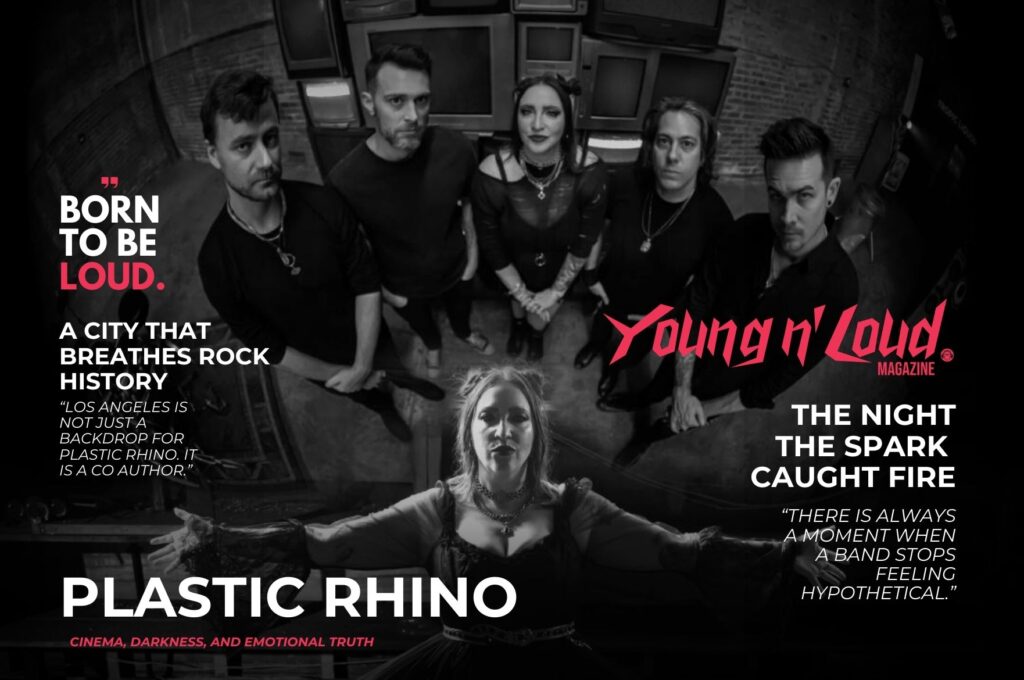
Los Angeles is not just a backdrop for Plastic Rhino. It is a co author. Jack is a true Valley native, born and raised in Los Angeles. Atara Glazer the vocalist was also born in the city, though her path took her elsewhere before inevitably pulling her back. That return mattered. Los Angeles shaped their sound, their image, and their mindset in ways that no other city could.
The rock lineage of Los Angeles is unavoidable. It lives in the walls of venues, in the mythology of the Sunset Strip, and in the ghosts of artists who turned rebellion into legacy. Playing at the Whisky A Go Go is not just a performance. It is a rite of passage. Sitting at the Rainbow Bar and Grill is not just a meal. It is communion with decades of rock history.
For Plastic Rhino, being part of that lineage is both an honor and a responsibility. Their music does not imitate the past, but it respects it. Los Angeles taught them that rock is not just a genre. It is an attitude, a survival instinct, and a refusal to disappear quietly.
The Night the Spark Caught Fire
There is always a moment when a band stops feeling hypothetical. For Plastic Rhino, that moment came in 2013 at The Viper Room. At the time, the band was stripped down to its core. Just Jack and the vocalist, supported by bass and guitar tracks. She played keys and sang. Jack handled guitar. They performed four original songs from their EP and two covers.
The room was not overflowing. The crowd was respectable but modest. None of that mattered. Standing on that stage, delivering those songs, something shifted. The energy was undeniable. The feeling was complete. That performance ignited the internal certainty that this was not a project or a phase. It was the path forward. The fire was lit, and neither of them had any intention of putting it out.

Naming the Unlikely Beast
The name Plastic Rhino did not arrive through symbolism or elaborate mythology. It came through instinct and experimentation. Two columns of random words were written down. The band began combining them, searching for something that felt distinctive without being forced. An animal felt right. Strength, presence, and oddity mattered. When Plastic and Rhino came together, it simply worked.
The name carries a contradiction that mirrors the band itself. Synthetic and raw. Artificial and powerful. Familiar and strange. Plastic Rhino became not just a name, but a container for everything the band would become.
Sound Without Permission
Ask Plastic Rhino to define their music and the resistance to labels becomes immediate. Comparisons are inevitable, but definitions are limiting. The vocalist describes the band as a collision between Halestorm, Bring Me The Horizon, and Spiritbox. Jack leans toward Heavy Alternative Rock. Listeners unfamiliar with heavier sounds often draw comparisons to Hayley Williams, a parallel the band firmly rejects as reductive. Gender does not dictate genre, and Plastic Rhino refuses to be boxed into assumptions based on who is holding the microphone.
The truth is simpler. Their music is meant to be felt before it is categorized. Energy, hooks, aggression, vulnerability, and release coexist in every track. Whether the listener headbangs, dances, cries, or finds the soundtrack to an intimate moment, the band considers that a success.
Inside the Machine of Creation
Plastic Rhino’s creative process is deeply collaborative, built on years of shared language and trust. Ideas begin everywhere. Voice notes recorded on phones. Guitar riffs and bass lines living on hard drives. Each song starts as a fragment and grows through mutual understanding.
Their upcoming single “Dark Horizon,” scheduled for release on February 25, 2026, stands as a defining example of this process. Jack began with a synth line created by reversing the Halloween theme, paired with a simple drum pattern. When he brought it into the room with Atara Glazer the and Tom Chandler, the concept locked instantly.
The word horizon surfaced during scratch vocals and became the emotional anchor of the song. Lyrics formed quickly, circling themes of depression and emotional endurance. Guitar and bass evolved organically. Drum ideas took shape on a keyboard before being transformed entirely by producer Ron Geffen, who re-recorded the drums with ferocious double kick patterns that pushed the song into a heavier, more aggressive realm. The result is Plastic Rhino at their heaviest, their most refined, and their most fearless.
Cinema, Darkness, and Emotional Truth
Film plays a significant role in shaping Plastic Rhino’s artistic direction, particularly horror. The band gravitates toward narratives that explore fear, darkness, and psychological tension. These cinematic instincts bleed directly into the lyrics, which often function as short stories rather than abstract expressions.
“Dark Horizon” exemplifies this approach. It confronts depression not as a weakness, but as a lived reality that can become strangely familiar. The song explores the idea of embracing sadness, of wearing darkness as armor rather than hiding from it. This honesty defines Plastic Rhino’s work. Their music does not seek comfort. It seeks recognition.

A Voice You Cannot Mistake
Instrumentation shifts. Tunings change. Production evolves. Yet one element remains unmistakable. The voice. Jack’s rig relies on a Blackstar tube amplifier paired with Line 6 Helix effects, typically played through Schecter guitars and basses. These tools shape the band’s live presence, but the constant thread is the vocal identity at the center. It is raw, commanding, and immediately recognizable. No matter how Plastic Rhino evolves, that voice remains the signature.
Milestones That Redefined Belief
Recognition arrived in moments that felt surreal. Airplay on Sirius XM validated years of persistence. Recording “I Rise” at Real World Studios in the United Kingdom expanded their sense of possibility. Participating in an intensive producer camp, writing and recording within three days alongside respected figures from the British music scene, reshaped their understanding of collaboration.
Then there are the quieter victories. Seeing Shazam data light up across the globe. Discovering unexpected listener concentrations in places like Mexico City, particularly for their cover of “Hole In The Sky.” These moments remind the band that music travels farther than intention.
Lessons Learned the Hard Way
Plastic Rhino speaks candidly about setbacks, particularly their experience with indie labels. The lesson was simple and hard earned. Do not pay up front. Do not chase promises that sound too perfect. Independence offers control, clarity, and sustainability. In an era where artists can manage much of their own distribution and promotion, Plastic Rhino advocates for self trust and community based collaboration over exploitative arrangements.
Evolution Through Heaviness
From their early releases rooted in nineties alternative textures to their current embrace of modern nu metal and heavy rock, Plastic Rhino has never stopped evolving. Atara Glazer the vocalist’s use of fry screaming, now a prominent feature, marks a personal and artistic transformation. Each new song represents growth rather than repetition. “Dark Horizon” stands as the heaviest track in their catalog, a clear signal that the band is not retreating into comfort.
The Stage as Sacred Ground
Live performance remains the heartbeat of Plastic Rhino. A standout moment came at Bar Sinister in Los Angeles, where a packed room mirrored the band’s intensity back at them. Yet for the band, every show carries equal weight. One hundred and ten percent is the baseline. Anything less would be dishonest.

Breaking the Myth of the Female Fronted Band
Plastic Rhino confronts a persistent misconception within rock culture. The idea that female vocalists must conform to pop punk aesthetics or visual expectations is not just inaccurate, it is limiting.
The band openly challenges the lack of respect afforded to women in heavy alternative and metal spaces. While progress has been made, there remains a long road ahead. Plastic Rhino refuses to play into the double standard where women are evaluated by appearance before talent. Their stance is clear. Skill comes first. Always.
Balance Behind the Chaos
At its core, Plastic Rhino is a partnership. The vocalist manages the business and operational side with precision. Jack focuses on creative visuals and conceptual direction. Together, they form a balanced system supported by a rotating cast of trusted live musicians.
Offstage, grounding comes through simple rituals. Dogs. Films. Friendship. A tight knit Los Angeles music community built on mutual support rather than competition. Physical care through reformer Pilates helps sustain the demands of performance. Before stepping onstage, preparation is intentional. Listening to current influences. Vocal warm ups. Stretching. Centering.
A Palette of Black Silk and Sharp Edges
If Plastic Rhino’s music had a sensory identity, it would be black silk. Smooth yet dangerous. Elegant yet abrasive. Paired with the bite of a dirty martini, it reflects the band’s balance of refinement and rebellion.
Beyond Sound, Toward Meaning
Plastic Rhino wants listeners to feel seen. Their music explores depression, anger, lust, love, injustice, and survival because life is not sanitized. It is complicated, often brutal, and deeply emotional. Women’s rights stand at the center of their message. The band confronts the devaluation of women in male dominated industries, particularly the pressure placed on female performers to prioritize appearance over ability. Plastic Rhino rejects that narrative entirely. Their work is a declaration. Talent deserves space. Expression deserves respect. Darkness deserves honesty. Plastic Rhino is not here to be palatable. They are here to be real.